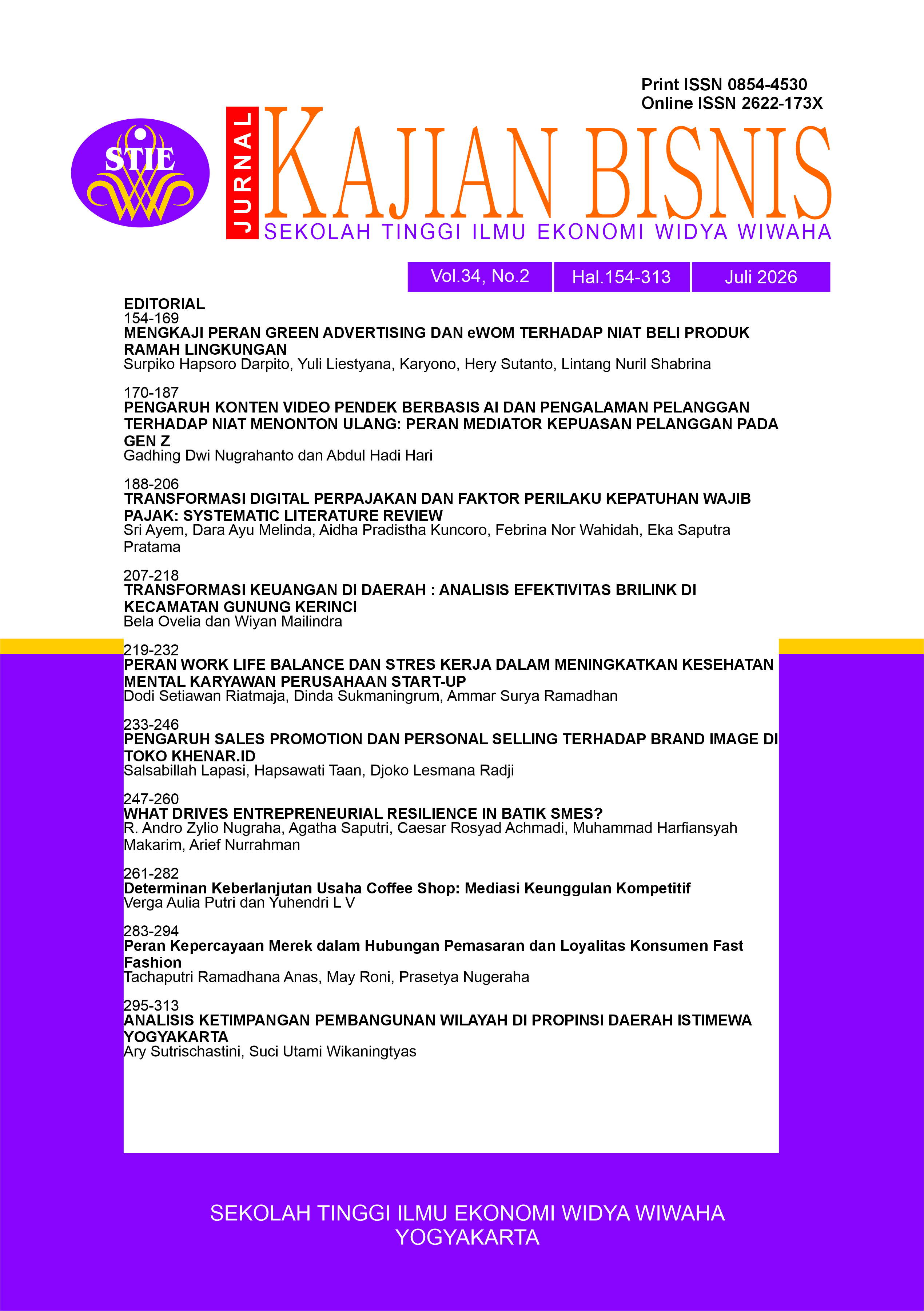
ANALISIS KETIMPANGAN PEMBANGUNAN WILAYAH DI PROPINSI DAERAH ISTIMEWA YOGYAKARTA
DOI:
https://doi.org/10.32477/8scw0n13Keywords:
Development Inequality, Regional Development, Indeks Williamson, Gini Ratio, Loqation QoutientAbstract
In regional economic studies, the issue of development inequality between regions is a significant topic of interest, including in the Special Region of Yogyakarta. According to data from the Central Statistics Agency (BPS) in March 2025, the Gini ratio in the Special Region of Yogyakarta was higher than the national average. This indicates a greater income gap in Yogyakarta. The objective of this study was to analyze regional development inequality and identify leading sectors with potential for development in the Special Region of Yogyakarta.
The research was conducted in the Special Region of Yogyakarta Province. The data sources were secondary data collected from the BPS for 2020–2024, including per capita GRDP and the population of the Special Region of Yogyakarta (DIY). The analysis tool used was the Williamson Index to measure regional development inequality and the Location Quotient (LQ) to determine leading or base sectors.
The results showed that regional development inequality in the Special Region of Yogyakarta Province was categorized as high, with an average Williamson Index value of 0.51658597. Meanwhile, the LQ analysis results showed that Yogyakarta City has ten basic sectors, followed by Gunung Kidul Regency with seven basic sectors, Bantul and Kulon Progo Regencies each with six basic sectors. Meanwhile, Sleman Regency has the fewest leading sectors, with five.
Downloads
References
Arsyad, L. (2016). Ekonomi Pembangunan dan Pembangunan Ekonomi Daerah. Yogyakarta: BPFE
Arsyad, L. (2010). Ekonomi pembangunan. Yogyakarta: UPP STM YKPN.
Ambar, A., Walewangko, E. N. dan TumangkengS. Y. L. (2021). Analisis Disparitas Pembangunan Ekonomi Antar Wilayah Kabupaten/Kota di Provinsi Maluku Utara Tahun 2015-2019,” J. Berk. Ilmu Efisiensi, vol. 21, no. 1.
Asmanita. (2012). Analisis Ketimpangan Pendapatan (Studi Kasus: Propinsi Sumatera Selatan Dan Bengkulu). Jurnal Media Wahana Ekon., vol. Vol. 9 No., hal. 67–75. [Daring]. Tersedia pada: file:///C:/Users/hp/Downloads/admin,+7.+Asmanita.pdf.
Bappenas. (2020). Rencana Pembangunan Jangka Menengah Nasional (RPJMN) 2020-2024. Jakarta: Bappenas.
Candrawati, C. dan Nugroho, Alih Aji (2024). Analisis Potensi dan Ketimpangan Pembangunan Kabupaten/Kota di Provinsi Kepulauan Riau.Jurnal Good Governance., vol. 20 No, hal. 143–159, [Daring]. Tersedia pada: file:///C:/Users/hp/Downloads/5.+Cindy+Candrawati,+Alih+Aji+Nugroho.pdf.
Fahmi, N. dan Maria, N.S.B. (2023). Analisis Determinan Ketimpangan Wilayah Di Propinsi Daerah Istimewa Yogyakarta (DIY) Tahun 2013-2020. Diponegoro Journal of Economics. Vol. 12 No. 2, https://doi.org/10.14710/djoe.37965
Glasson, J. (1990). An Introduction to Regional Planning. London: Routledge.
Gluschenko, Konstantin. (2015). ‘Williamson’s Fallacy in Estimation of Inter-Regional Inequality. Institute of Economics and Industrial Engineering, Siberian Branch of the Russian Academy of Sciences, Novosibirsk State University. Munich Personal RePEc Archive (MPRA) paper, No. 68019, Posted 23 Nov 2015 06:18 UTC. https://mpra.ub.uni-muenchen.de/68019/
Haggett, P. (2001). Geography: A Global Synthesis. London: Pearson Education.
Harini, R., Giyarsih, S. R dan Budiani, S. R. (2005). Analisis Sektor Unggulan Dalam Penyerapan Tenagakerjadi Daerah Istimewa Yogyakarta. Majalah Geografi Indonesia Vol. 19 No. 1, Yogyakarta, hal. 1–20.
Isard, W. (1960). Methods of Regional Analysis. Cambrige: MT Press.
Krugman, P. (1991). Geography and Trade. MIT Press.
Kuncoro, M. (2004). Otonomi dan Pembangunan Daerah Revormasi, Perencanaan, Strategi dan Peluang. Jakarta: Erlangga.
Kuncoro, M. (2010). Ekonomika Pembangunan: Masalah, Kebijakan, dan Politik. Jakarta: Erlangga.
Kuznets, S. (1996). Modern Economic Growth. Yale University Press.
Mawardi, Ikhwanudin. (2007). Perencanaan Pembangunan Wilayah Berdasarkan Konsep Produktifitas Unggulan. Jurnal Teknologi LIngkungan, Vol. 8, No. 2, Hal 181-187.
North, D. C. (1990). Institutions, Institutional Change and Economic Performance. Cambridge University Press.
Perroux, F. (1955). Note sur la notion de pôle de croissance. Économie Appliquée, 8, pp. 307–320.
Prabowo, D. (2023). Analysis Of The Leading Sector of Kota Pelajar with Location Quotient Method and Klassen Typology. Jurnal Pajak dan Keuangan Negara.Vol. 24 No. 1, Hal 55-72. DOI:
https://doi.org/10.31092/jpkn.v5i1.2251
Putra, W. (2018). Perekonomian Indonesia Penerapan Beberapa teori Ekonomi Pembangunan di Indonesia. PT Raja Grafindo Persada.
Restiatun. (2009). Identifikasi sektor Unggulan dan Ketimpangan Antar Kabupaten/Kota di Provinsi Daerah Istimewa Yogyakarta. Jurnal Ekonomi dan studi Pembangunan, Vol. 10 No. 1, Hal 77-98.
Romer, P. M. (1990). Endogenous Technological Change. Journal of Political Economy, 98 (5).
Tarigan, R. (2014). Ekonomi Regional: Teori dan Aplikasi, Jakarta: Bumi aksara.
Todaro, M., & Smith, S. C. (2011). Economic Development (11th ed.). In Economic Development.
Todaro, M. P., & Smith, S. C. (2015). Economic Development (12th ed.). Boston: Pearson.
Richardson, H. W. (1973). Regional Growth Theory. London: Macmillan.
Richardson, H. W. (1978). Regional and Urban Economics. Harmondsworth: Penguin Books.
Setyanto, A.dan Irawan, B. (2016). Pembangunan Berbasis Wilayah: Dasar Teori, Konsep Operasional Dan Implementasinya Di Sektor Pertanian,” Ekoregion.
Sjafrizal. (2012). Ekonomi Wilayah dan Perkotaan. Jakarta: Rajawali Pers.
Sjafrizal. (2014). Perencanaan Pembangunan Daerah dalam Era Otonomi. Jakarta: Rajawali Pers.
Sutrischastini, A. (2020). Pertumbuhan Ekonomi Berbasis Ekspor Di Kabupaten Gunung Kidul. Jurnal Ekonomi dan Bisnis (JEB).Vol. 14. No. 2.Hal. 101-109. DOI: https://doi.org/10.53916/jeb.v14j2
Sutrischastini, A., Gusti, Y. K., Sofiati, Linawati, Firdarini, K. C. (2024). Penerapan Shift Share Arcelus Di Daerah Istimewa Yogyakarta. Jurnal Riset Akuntansi. dan Bisnis Indonesia. STIE Widya Wiwaha, vol. Vol. 4 No., hal. 959–972.Tersedia pada: https://drive.google.com/file/d/1TQun2UAj7kklu7k5ZBDj6JCfMF9g-XXi/view.
Wibowo, K. (2003). Pembangunan dan Pertumbuhan Ekonomi: Kerangka Teoritis dan Aplikasinya. ESPA4424/Modul 1.
Williamson, J. G. (1965). Regional Inequality and the Process of Natural Developmant: A Description and the Pratterns. Economic Development and Cultural Change, Vol 13 (4), Page 1-84.
Zofan, R. R., Wicaksono, A. D., dan Wijayanti, Wawargita Permata. (2023). Prioritas Penanganan Tingkat Kesenjangan Wilayah Antar Kecamatan Di Kabupaten Solok Selatan. J. Plan. Urban Reg. Environ., Vol. 12, [Daring]. Tersedia pada: file:///C:/Users/hp/Downloads/603-1472-1-PB.pdf.
Downloads
Published
Issue
Section
License
Copyright (c) 2026 Ary Sutrischastini, Suci Utami Wikaningtyas

This work is licensed under a Creative Commons Attribution 4.0 International License.