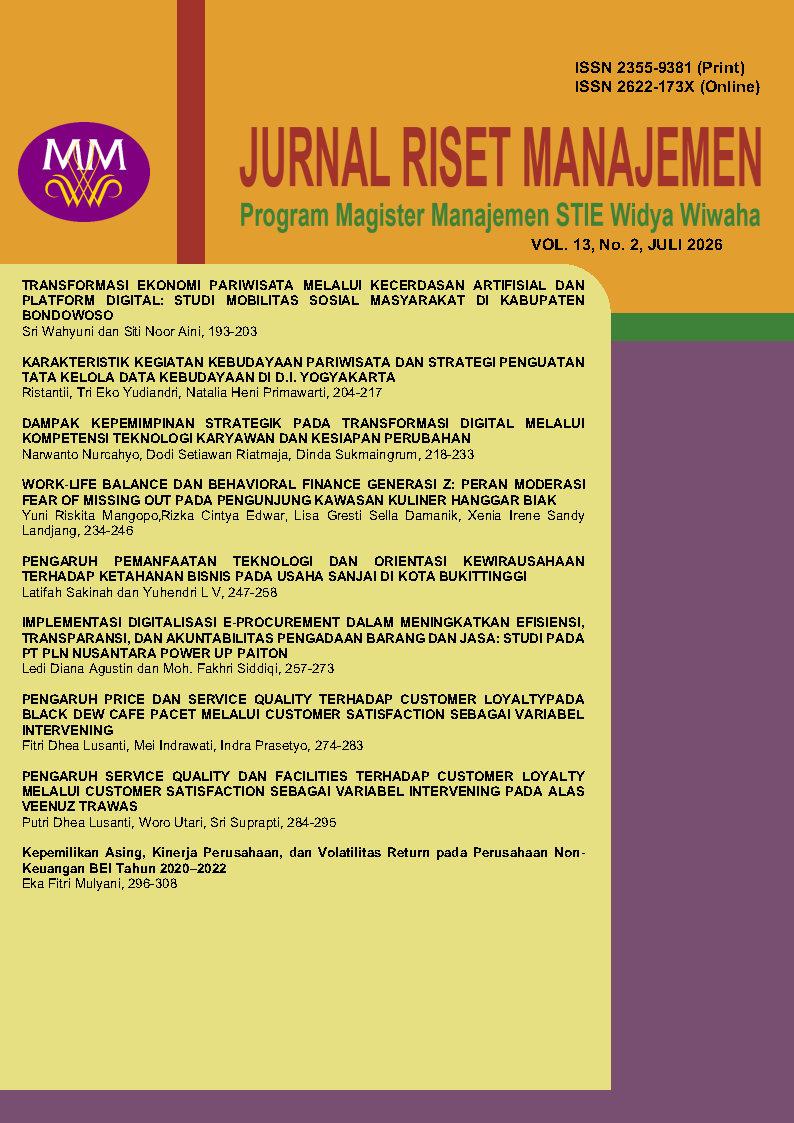
TRANSFORMASI EKONOMI PARIWISAATA MELALUI KECERDASAN ARTIFISIAL DAN PLATFORM DIGITAL: STUDI MOBILITAS SOSIAL MASYARAKAT DI KABUPATEN BONDOWOSO
DOI:
https://doi.org/10.32477/geqepf57Keywords:
artificial intelligence, digital platforms, tourism economic transformation, social mobility, BondowosoAbstract
This study examines the role of artificial intelligence (AI) and digital platforms in supporting tourism economic transformation and social mobility in Bondowoso Regency, Indonesia. The rapid development of digital technology has significantly influenced tourism activities by changing patterns of promotion, service delivery, and market access for local communities. In Bondowoso, tourism development has increasingly contributed to economic diversification, particularly through nature-based tourism, agro-tourism, and community-based tourism activities. However, the integration of AI and digital technology remains uneven due to differences in digital literacy, infrastructure, and local adaptive capacity.
This research employs a mixed-methods approach by integrating qualitative field research and the Analytic Hierarchy Process (AHP). Data were collected through field observation, in-depth interviews, focus group discussions, and structured questionnaires involving tourism actors, small business owners, and local stakeholders. The AHP method was used to identify priority factors influencing tourism digital transformation.
The findings indicate that digital literacy is the most influential factor in tourism economic transformation, followed by digital infrastructure, AI utilization, policy support, and stakeholder collaboration. Digital platforms have enabled local communities to expand tourism promotion, increase market access, and create alternative sources of income, thereby contributing to social mobility. Although AI adoption remains at an early stage, its presence has begun to support tourism marketing efficiency and digital communication.
The study concludes that tourism digital transformation in Bondowoso requires strengthening human resource capacity, improving digital infrastructure, and promoting context-based technological innovation to ensure inclusive and sustainable local economic development.
References
Buhalis, D., & Law, R. (2008). Progress in information technology and tourism management: 20 years on and 10 years after the internet—The state of eTourism research. Tourism Management, 29(4), 609–623. https://doi.org/10.1016/j.tourman.2008.01.005
Graham, M., Hjorth, I., & Lehdonvirta, V. (2017). Digital labour and development: Impacts of global digital labour platforms and the gig economy on worker livelihoods. Transfer: European Review of Labour and Research, 23(2), 135–162. https://doi.org/10.1177/1024258916687250
Huang, M. H., & Rust, R. T. (2021). Artificial intelligence in service. Journal of Service Research, 24(1), 3–19. https://doi.org/10.1177/1094670520902266
Kenney, M., & Zysman, J. (2016). The rise of the platform economy. Issues in Science and Technology, 32(3), 61–69.
Thomas L. Saaty Saaty, T. L. (2008). Decision making with the analytic hierarchy process. International Journal of Services Sciences, 1(1), 83–98. https://doi.org/10.1504/IJSSCI.2008.017590
Referensi Buku
Brynjolfsson, E., & McAfee, A. (2014). The second machine age: Work, progress, and prosperity in a time of brilliant technologies. W. W. Norton & Company.
Pine, B. J., & Gilmore, J. H. (1999). The experience economy. Harvard Business School Press.
Porter, M. E. (1990). The competitive advantage of nations. Free Press.
Selwyn, N. (2016). Education and technology: Key issues and debates. Bloomsbury Academic.
Warschauer, M. (2003). Technology and social inclusion: Rethinking the digital divide. MIT Press.
Downloads
Published
Issue
Section
License
Copyright (c) 2026 Sri Wahyuni dan Siti Noor Aini

This work is licensed under a Creative Commons Attribution 4.0 International License.