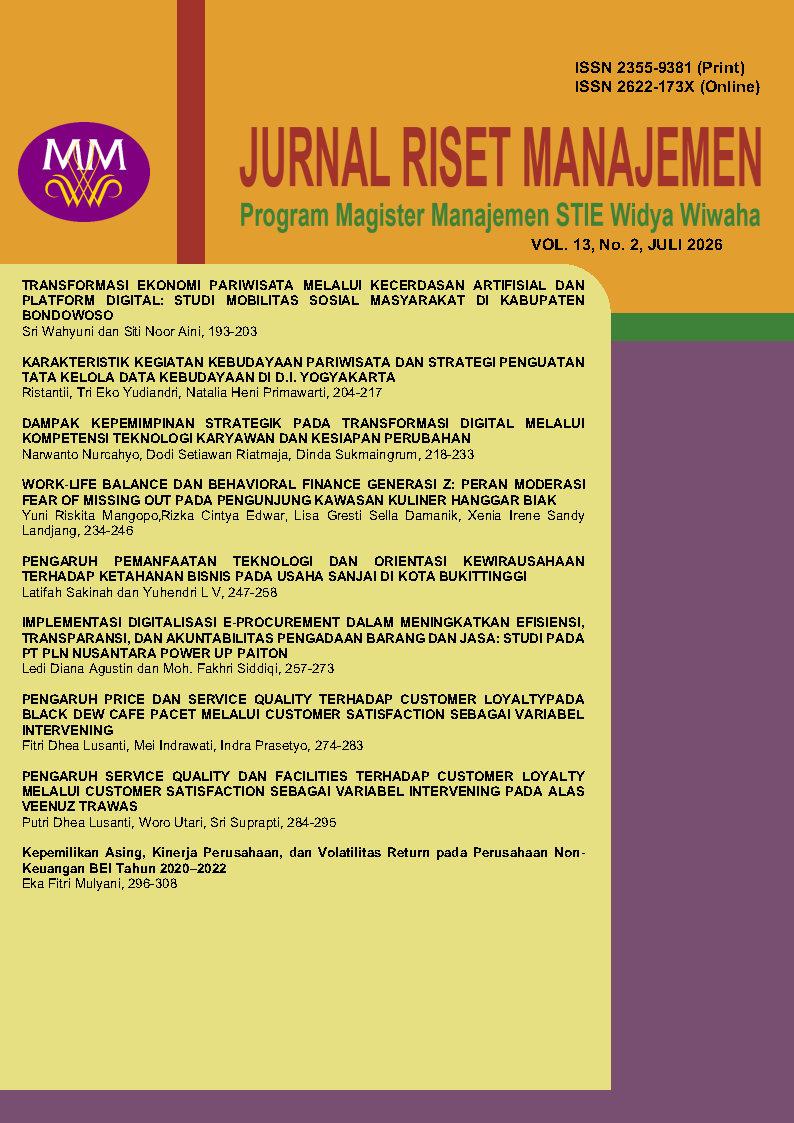
DAMPAK KEPEMIMPINAN STRATEGIK PADA TRANSFORMASI DIGITAL MELALUI KOMPETENSI TEKNOLOGI KARYAWAN DAN KESIAPAN PERUBAHAN
DOI:
https://doi.org/10.32477/mxdcgm59Keywords:
Strategic Leadership, Technology Competence, Change Readiness, Digital TransformationAbstract
This research aims to analyze the impact of strategic leadership on digital transformation, considering the mediating roles of employee technological competence and change readiness. Digital transformation is increasingly becoming a strategic necessity for organizations, but its success is not solely determined by technological investment, but also by human resource readiness and leadership effectiveness in guiding the change process. The research employs a quantitative approach with an explanatory design through SEM-PLS. The sample consists of 210 employees from organizations in Yogyakarta who have been involved in digitalization initiatives, determined based on the rule of thumb of ten times the largest number of indicators. Analysis was conducted using SmartPLS 4.0 to assess construct validity, reliability, inter-variable relationships, and mediating roles. The results indicate that strategic leadership does not have a direct effect on digital transformation, but it significantly influences technological competence and change readiness. Both of these variables are proven to have a significant influence on digital transformation and act as mediators in the relationship between strategic leadership and digital transformation. These findings confirm that digital transformation is more effective when leaders are capable of strengthening digital competence and building change readiness in the work environment. This research contributes theoretically to understanding the internal mechanisms connecting strategic leadership with successful digital transformation, and provides practical implications for organizations in designing digital strategies based on technological and human readiness.
References
Adobor, H., Darbi, W. P. K., & Damoah, O. B. O. (2021). Strategy in the era of “swans”: The role of strategic leadership under uncertainty and unpredictability. Journal of Strategy and Management.
Alateeg, S., & Alhammadi, A. (2024). The impact of organizational culture on organizational innovation with mediation role of strategic leadership in Saudi Arabia. Journal of Statistics Applications & Probability, 13(2), 843–858.
Aldhi, I. F., Suhariadi, F., Rahmawati, E., Supriharyanti, E., Hardaningtyas, D., Sugiarti, R., & Abbas, A. (2025). Bridging digital gaps in smart city governance: The mediating role of managerial digital readiness and the moderating role of digital leadership. Smart Cities, 8(4), 117.
Alsarayreh, R. S. (2023). The effect of technological skills on developing problem solving skills: The moderating role of academic achievement. International Journal of Instruction, 16(2), 369–388.
Baiyere, A., Salmela, H., & Tapanainen, T. (2020). Digital transformation and the new logics of business process management. European Journal of Information Systems, 29(3), 238–259.
Behrens, V. J., Pjero, E., Krause, S., & Hangl, J. (2023). What are the essential elements of a digital transformation process to develop an efficient digitization strategy for management? Journal of Management Development, 42(5), 399–419.
Brügger, A. (2020). Understanding the psychological distance of climate change: The limitations of construal level theory and suggestions for alternative theoretical perspectives. Global Environmental Change, 60, 102023.
Cao, T. T., & Le, P. B. (2024). Impacts of transformational leadership on organizational change capability: A two-path mediating role of trust in leadership. European Journal of Management and Business Economics, 33(2), 157–173.
Chen, M., Martins, T. S., Zhang, L., & Dong, H. (2025). Digital transformation in project management: A systematic review and research agenda. Systems, 13(8), 625.
Davis, J. (2024). Role of strategic leadership in fostering a culture of innovation within organizations. International Journal of Strategic Management, 3(5), 1–13.
Falloon, G. (2020). From digital literacy to digital competence: The teacher digital competency (TDC) framework. Educational Technology Research and Development, 68(5), 2449–2472.
Giroth, L. G. J., Purnomo, K. D. M., Dotulong, F., Mokoginta, D., & Pusung, P. H. (2024). Konsep, urgensi dan strategi pembangunan literasi digital. Journal of Digital Literacy and Volunteering, 2(2), 83–90.
Hafez, M. (2022). Strategic change leadership: Aligning team efforts with organizational goals for sustainable change. SSRN. https://doi.org/10.2139/ssrn.4802280
Hair, J. F., Hult, G. T. M., Ringle, C. M., Sarstedt, M., & Danks, N. (2021). Partial least squares structural equation modeling (PLS-SEM) using R: A workbook. Springer.
Hargitai, D. M., & Bencsik, A. (2023). The role of leadership in digital learning organizations. Emerging Science Journal, 7(Special Issue 2), 111–124.
Hermawan, R., Anggraeni, R. D., Amar, M. Y., Kadir, A. R., & Hamid, N. (2024). The influence of visionary leadership on the success of organizational transformation. An-Nuha: Jurnal Sosial & Humaniora, 2(2), 100–108.
Holt, D. T., Armenakis, A. A., Feild, H. S., & Harris, S. G. (2007). Readiness for organizational change: The systematic development of a scale. The Journal of applied behavioral science, 43(2), 232-255.
Jewapatarakul, D., & Ueasangkomsate, P. (2024). Digital organizational culture, organizational readiness, and knowledge acquisition affecting digital transformation in SMEs from food manufacturing sector. Sage Open, 14(4), 21582440241297405.
Kominfo. (2023). Laporan Transformasi Digital Indonesia 2023. Kementerian Komunikasi dan Informatika Republik Indonesia.
Kretschmer, T., & Khashabi, P. (2020). Digital transformation and organization design: An integrated approach. California Management Review, 62(4), 86–104.
Kurzhals, C., Graf‐Vlachy, L., & König, A. (2020). Strategic leadership and technological innovation: A comprehensive review and research agenda. Corporate Governance: An International Review, 28(6), 437–464.
Masoud, R., & Basahel, S. (2023). The effects of digital transformation on firm performance: The role of customer experience and IT innovation. Digital, 3(2), 109–126.
Mumtaz, S., Selvarajah, C., & Meyer, D. (2024). How does human relations climate and organizational support affect readiness to change? The mediating role of employee participation and leadership excellence. Global Business and Organizational Excellence, 43(2), 79–91.
Noviyanti, A. (2025). The role of transformational leadership in adaptive business strategy implementation in the VUCA era. Sistem, Informasi, Manajemen, dan Bisnis Adaptif (SIMBA), 1(1).
Obadha, T. W., & Deya, J. (2020). Effects of strategic leadership on change management in African Union Regional Standby Force. International Academic Journal of Human Resource and Business Administration, 3(9), 166–177.
Olofsson, A. D., Fransson, G., & Lindberg, J. O. (2020). A study of the use of digital technology and its conditions with a view to understanding what ‘adequate digital competence’ may mean in a national policy initiative. Educational Studies, 46(6), 727–743.
Purnawan, L. (2025). Reconstructing organizational culture in the era of digital transformation: A study of change readiness among employees. RIGGS: Journal of Artificial Intelligence and Digital Business, 4(2), 3614–3623.
Rubel, M. R. B., Kee, D. M. H., & Rimi, N. N. (2023). Promoting technology innovation performance through high involvement HRM, technology adaptation and innovativeness. Business Process Management Journal, 29(5), 1277–1302.
Saemaldaher, K., & Emeagwali, O. L. (2025). The role of open innovation in enhancing organizational resilience and sustainability performance through organizational adaptability. Sustainability, 17(13), 5846.
Schiuma, G., Schettini, E., Santarsiero, F., & Carlucci, D. (2022). The transformative leadership compass: Six competencies for digital transformation entrepreneurship. International Journal of Entrepreneurial Behavior & Research, 28(5), 1273–1291.
Serafimova, V., & Vasilev, V. (2024). Digital culture as a competitive advantage in the sustainable development of organizations. Agora International Journal of Economical Sciences, 18(1), 210–222.
Sunoto, S. P., & Daryanto, E. (2025). The role of strategic leadership in building organizational resilience. International Journal of Integrative Sciences, 4(3), 517–532.
Șișu, J. A. (2023). Digital leadership competencies: A systematic literature review. Revista de Management Comparat Internațional, 24(1), 69–77.
Tirastittam, P., Jermsittiparsert, K., Waiyawuththanapoom, P., & Aunyawong, W. (2020). Strategic leadership, organizational innovativeness, and the firm supply performance: The mediating role of information technology capability. International Journal of Supply Chain Management, 9(2), 291–299.
Trenerry, B., Chng, S., Wang, Y., Suhaila, Z. S., Lim, S. S., Lu, H. Y., & Oh, P. H. (2021). Preparing workplaces for digital transformation: An integrative review and framework of multi-level factors. Frontiers in Psychology, 12, 620766.
Wang, T., Olivier, D. F., & Chen, P. (2023). Creating individual and organizational readiness for change: Conceptualization of system readiness for change in school education. International Journal of Leadership in Education, 26(6), 1037–1061.
Weiner, B. J. (2020). A theory of organizational readiness for change. In Handbook on implementation science (pp. 215–232). Edward Elgar Publishing.
Younus, A. M., & Zaidan, M. N. (2022). The mediating role of organizational readiness and resilient leadership effect on the performance of business corporations in Belgium. Gospodarka i Innowacje, 24, 334–345.
Zhang, X., Xu, Y., & Ma, L. (2022). Research on successful factors and influencing mechanism of the digital transformation in SMEs. Sustainability, 14(5), 2549.
Downloads
Published
Issue
Section
License
Copyright (c) 2026 Narwanto Nurcahyo, Dodi Setiawan Riatmaja, Dinda Sukmaingrum

This work is licensed under a Creative Commons Attribution 4.0 International License.