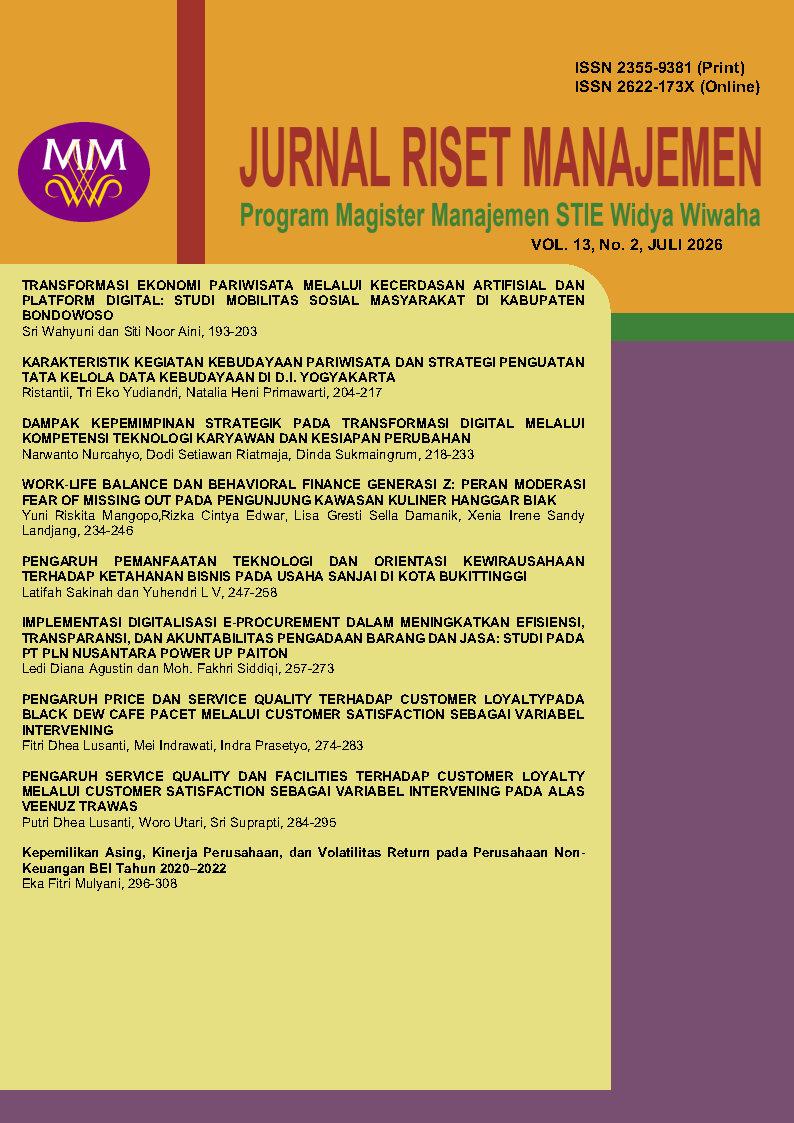
WORK-LIFE BALANCE DAN BEHAVIORAL FINANCE GENERASI Z: PERAN MODERASI FEAR OF MISSING OUT PADA PENGUNJUNG KAWASAN KULINER HANGGAR BIAK
DOI:
https://doi.org/10.32477/qqzqqs46Keywords:
Work-Life Balance, Fear of Missing Out, Financial Behavior, Generasi Z, BiakAbstract
This study aims to analyze the effect of Work-Life Balance on the Financial Behavior of Generation Z and to examine the moderating role of Fear of Missing Out (FOMO) among visitors to the Hanggar Biak Culinary Area. This study is considered important because the financial behavior of Generation Z is influenced not only by rational factors, but also by digital social dynamics and consumptive lifestyles that develop through social media. The study employed a quantitative approach using the Partial Least Squares Structural Equation Modeling (PLS-SEM) method. Data were collected through questionnaires distributed to Generation Z individuals who had engaged in consumption activities in the Hanggar Biak Culinary Area. The model was evaluated through outer model and inner model assessments, while hypothesis testing was conducted using the bootstrapping procedure. The results indicate that Work-Life Balance has a positive and significant effect on Financial Behavior. These findings suggest that an individual’s ability to maintain a balance between work and personal life contributes to more directed and responsible financial management behavior. Fear of Missing Out (FOMO) was also found to have a positive and significant effect on Financial Behavior, indicating that digital social pressure and the urge to follow trends influence the financial behavior of Generation Z. However, FOMO was not able to moderate the relationship between Work-Life Balance and Financial Behavior. This study provides an empirical perspective on the financial behavior of Generation Z within the context of culinary areas as emerging spaces of digital social consumption in the modern era.
References
Ajzen, I. (1991). The Theory of Planned Behavior. Organizational Behavior and Human Decision Processes, 50(2), 179–211. https://doi.org/10.1016/0749-5978(91)90020-T
Benítez-Márquez, M. D., Sánchez-Teba, E. M., Bermúdez-González, G., & Núñez-Rydman, E. S. (2022). Generation Z within the workforce and in the workplace: A bibliometric analysis. Frontiers in Psychology, 12, 736820. https://doi.org/10.3389/fpsyg.2021.736820
Cahyasari, D. (2024). Analisis perilaku pengelolaan keuangan pada Generasi Z di Indonesia. Jurnal Lentera Bisnis, 13(2), 1199–1207. https://doi.org/10.34127/jrlab.v13i2.1155
Charles, C. E., & Immanuel, D. M. (2025). FOMO, materialism and the Gen Z shopping behavior: The impact on online impulse buying and post-purchase regret (with a gender perspective). Jurnal Aplikasi Manajemen, 23(1), 134–157. https://doi.org/10.21776/ub.jam.2025.023.1.08
Edwar, R. C., Mangopo, Y. R., Harju, L. M., Landjang, X. I. S., & Agustin, S. P. (2026). Peran mediasi financial well-being dalam pengaruh Work-Life Balance dan digital burnout terhadap financial behavior generasi Z. ARBITRASE: Journal of Economics and Accounting, 6(3), 861–872. https://doi.org/10.47065/arbitrase.v6i3.3106
Fahriansah, F., Safarida, N., & Midesia, S. (2023). Buy now, think later: Impulsive buying behavior among Generation Z in Indonesia. Share: Jurnal Ekonomi dan Keuangan Islam, 12(2), 386–421. https://doi.org/10.22373/share.v12i2.17453
Fisher, G. G. (2003). Work/personal life balance. In James C. Quick & Lois E. Tetrick (Eds.), Handbook of Occupational Health Psychology (pp. 143–162). American Psychological Association.
Fleetwood, S. (2007). Why work–life balance now? The International Journal of Human Resource Management, 18(3), 387–400. https://doi.org/10.1080/09585190601167441
Greenhaus, J. H., & Beutell, N. J. (1985). Sources of conflict between work and family roles. The Academy of Management Review, 10(1), 76-88. https://psycnet.apa.org/doi/10.2307/258214
Greenhaus, J. H., & Allen, T. D. (2011). Work–family balance: A review and extension of the literature. In J. C. Quick & L. E. Tetrick (Eds.), Handbook of Occupational Health Psychology (2nd ed., pp. 165–183). American Psychological Association. https://doi.org/10.2307/j.ctv1chs29w.14
Grzywacz, J. G., & Carlson, D. S. (2007). Conceptualizing work-family balance: Implications for practice and research. Advances in Developing Human Resources, 9(4), 455–471. https://doi.org/10.1177/1523422307305487
Hair, J. F., Hult, G. T. M., Ringle, C. M., & Sarstedt, M. (2022). A primer on partial least squares structural equation modeling (PLS-SEM) (3rd ed.). Sage.
IDN Research Institute. (2024). Indonesia Gen Z Report 2024. IDN Media.
Kalliath, T., & Brough, P. (2008). Work-Life Balance: A Review of the Meaning of the Balance Construct. Journal of Management and Organization, 14(3), 323–327. https://doi.org/10.5172/jmo.837.14.3.323
Khoirunnisa, R. A., & Purnamasari, P. E. (2024). Literasi keuangan memoderasi hubungan FoMO, love of money, dan self control terhadap pengelolaan keuangan pribadi. Jurnal E-Bis: Ekonomi Bisnis, 8(2), 724–739. https://doi.org/10.37339/e-bis.v8i2.1801
Mu, S., & Jurana, J. (2025). Financial behavior patterns of Generation Z: Netnographic analysis of the Fear of Missing Out (FoMO) phenomenon. Proceedings of 7th International Conference of Economic, Business and Government Challenges, 7(1), 23–34.
Nofsinger, J. R. (2014). The Psychology of Investing (5th ed.). Pearson Education.
Pompian, M. M. (2012). Behavioral Finance and Investor Types: Managing Behavior to Make Better Investment Decisions. John Wiley & Sons. https://doi.org/10.1002/9781119202417
Przybylski, A. K., Murayama, K., DeHaan, C. R., & Gladwell, V. (2013). Motivational, emotional, and behavioral correlates of Fear of Missing Out. Computers in Human Behavior, 29(4), 1841–1848. https://doi.org/10.1016/j.chb.2013.02.014
Robinson, E., Blissett, J., & Higgs, S. (2013). Social Influences On Eating: Implications for Nutritional Interventions. Nutrition Research Reviews, 26(2), 166–176. https://doi.org/10.1017/S0954422413000127
Sahi, S. K., Arora, A. P., & Dhameja, N. (2013). An exploratory inquiry into the psychological biases in financial investment behavior. Journal of Behavioral Finance, 14(2), 94–103. https://doi.org/10.1080/15427560.2013.790387
Saleh, C., & Kusumawardhani, R. (2025). Pengaruh financial knowledge, financial attitude, dan lifestyle terhadap financial management behavior Generasi Z di Kota Yogyakarta. Jurnal Manajemen Terapan dan Keuangan, 14(2), 741–754. https://doi.org/10.22437/jmk.v14i2.44233
Syandana, D. A., & Dhania, D. R. (2024). Hubungan antara Fear of Missing Out (FOMO) dan gaya hidup hedonis dengan impulsive buying pada mahasiswa pengguna e-commerce. Jurnal Ilmiah Manajemen, Ekonomi & Akuntansi (MEA), 8(3), 691–705. https://doi.org/10.31955/mea.v8i3.4502
Twenge, J. M. (2017). iGen: Why today's super-connected kids are growing up less rebellious, more tolerant, less happy and completely unprepared for adulthood. Atria Books.
Waworuntu, E. C., Kainde, S. J. R., & Mandagi, D. W. (2022). Work-Life Balance, job satisfaction and performance among millennial and Gen Z employees: A systematic review. Society, 10(2), 384–398. https://doi.org/10.33019/society.v10i2.464
Xiao, J. J., & Porto, N. (2017). Financial education and financial satisfaction: Financial literacy, behavior, and capability as mediators. International Journal of Bank Marketing, 35(5), 805–817. https://doi.org/10.1108/IJBM-01-2016-0009
Zanah, F. N., & Rahardjo, W. (2020). Peran Kesepian dan Fear of Missing Out Terhadap Kecanduan Media Sosial: Analisis Regresi Pada Mahasiswa. Persona: Jurnal Psikologi Indonesia, 9(2), 286-301. https://doi.org/10.30996/persona.v9i2.3386
Downloads
Published
Issue
Section
License
Copyright (c) 2026 Yuni Riskita Mangopo,Rizka Cintya Edwar, Lisa Gresti Sella Damanik, Xenia Irene Sandy Landjang

This work is licensed under a Creative Commons Attribution 4.0 International License.